
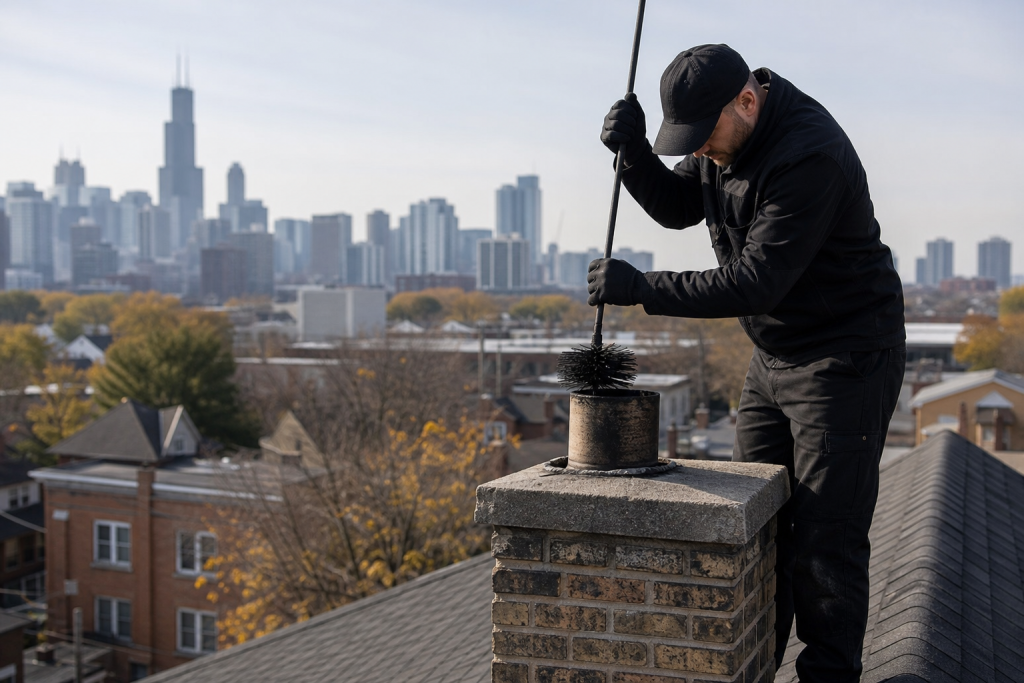
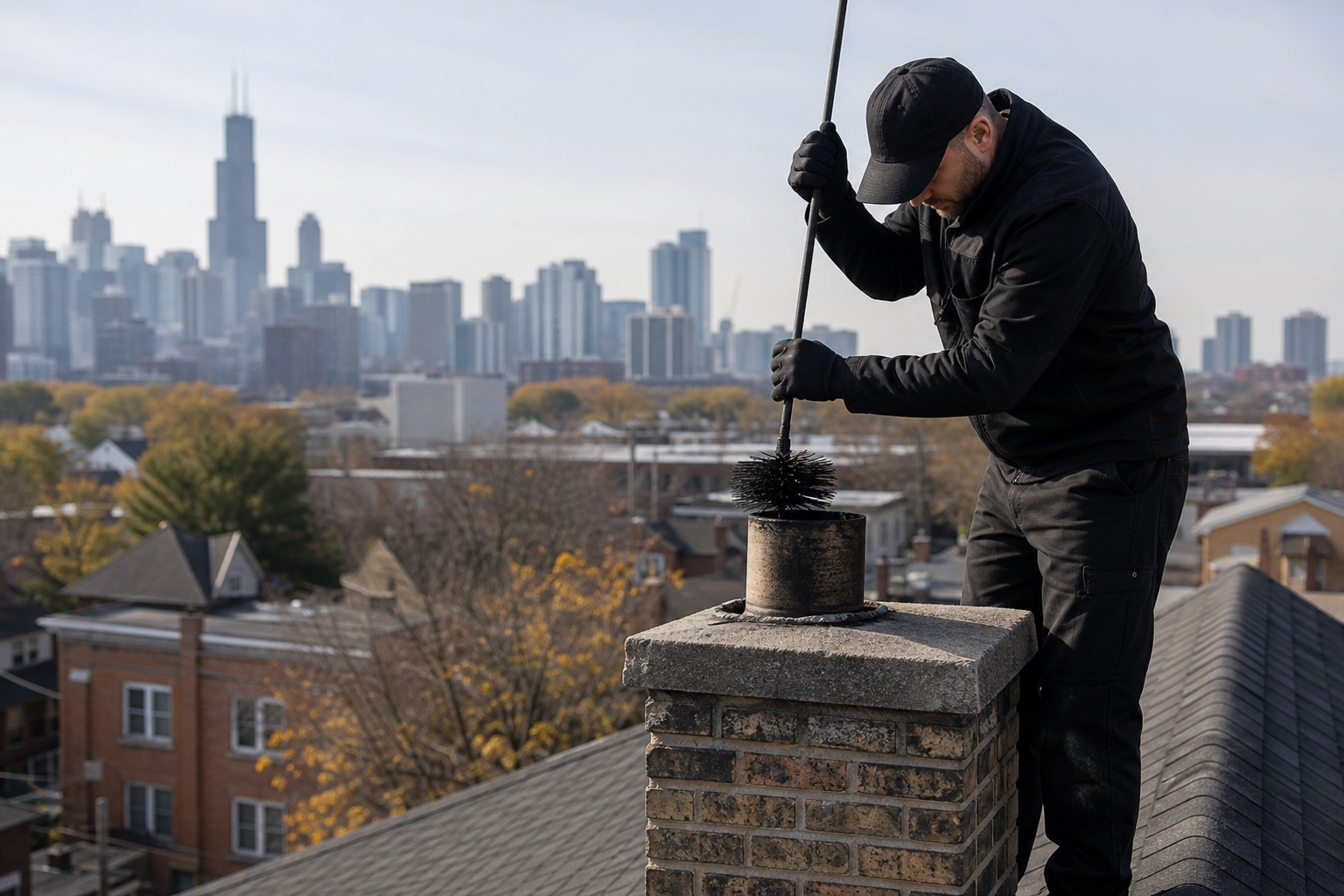
DuraFlex Chimney Cleaning & Sweep in Chicago: A Homeowner’s Guide
A proper DuraFlex chimney cleaning in Chicago costs between $250 and $450 for a standard single-flue system, and it requires specialized flexible brushes, camera inspection of the corrugated liner, and verification of termination cap integrity after our freeze-thaw season. Most sweeps in the Chicago market charge within this range, but fewer than half follow the protocol that DuraFlex and the Chimney Safety Institute of America actually recommend for stainless steel corrugated liners. If you’d rather not sort through who’s doing it right, call us at (888) 289-6055 - we’ll walk you through what your system needs, no charge for the conversation.
Most chimney sweeps carry the same brush set they’ve used for twenty years. That works fine for traditional clay tile flues with smooth walls and straight runs. But DuraFlex’s corrugated stainless steel liner has ridges that trap creosote in ways a standard round brush handles poorly, and almost no company mentions this to the homeowner until there’s a chimney fire or a failed inspection. We’ve been cleaning chimneys in Chicago for over 42 years, and in the last decade we’ve seen DuraFlex installations become the standard for relining older masonry chimneys - especially in neighborhoods like Lincoln Park, Oak Park, and Evanston where the housing stock dates to the 1920s and the original clay flues are cracked or oversized for modern appliances.
How DuraFlex Liner Geometry Changes the Cleaning Protocol
DuraFlex liners are made from continuous strips of 316Ti stainless steel, corrugated into a flexible tube that can navigate offset flues and tight bends. Those corrugations give the liner flexibility, but they also create valleys where stage-two and stage-three creosote accumulate. A standard poly or wire brush with a fixed diameter rides over the ridges rather than scraping the valleys clean.
Here’s what the geometry means in practice:
- Brush selection: DuraFlex requires a brush with flexible bristles that can deflect into the corrugation valleys. We use rotary cleaning systems with custom-sized whips or polypropylene heads sized to the liner’s inner diameter, not the nominal flue size.
- Rotation speed: High-speed rotary cleaning - the kind that works aggressively on clay tile - can damage thin-gauge DuraFlex if the operator doesn’t match RPM to liner gauge. The 0.005-inch and 0.006-inch gauges common in residential Chicago installations need controlled, moderate speed.
- Camera access: The same corrugations that trap creosote can snag inspection camera heads. A proper DuraFlex cleaning includes camera verification that the cleaning head passed the full liner length without leaving packed debris at offsets.
We’ve pulled cameras out of DuraFlex liners in Hyde Park where the previous sweep never ran a post-cleaning inspection, and the homeowner had six feet of packed creosote hiding behind an offset that the standard brush never touched. The sweep gave them a receipt. They didn’t get a clean flue.
CSIA and NFI Checkpoints Most Sweeps Skip on Flexible Liners
The Chimney Safety Institute of America and the National Fireplace Institute publish specific checkpoints for stainless steel liner systems. In our experience auditing competitor work across the Chicago area, these four get omitted more often than not:
- Liner gauge verification: The technician should confirm the installed gauge matches the appliance’s venting requirements. A 0.005-inch gauge rated for gas-only service should not be handling wood-burning temperatures. We’ve found mismatches in Portage Park and Albany Park where the original installer cut corners.
- Connector condition at the appliance: The flexible liner terminates in a rigid connector at the stove or insert. This junction sees thermal cycling every burn, and the sealant or mechanical connection degrades. CSIA requires visual inspection; NFI recommends physical verification of tightness.
- Liner continuity: The liner must run continuous from appliance to termination with no gaps, no sagging, and proper support spacing. DuraFlex specifies support every five feet vertically and at every offset. A camera inspection is the only way to verify this without disassembly.
- Termination cap and storm collar: The cap must be properly sized to the liner diameter, not jammed onto an oversized crown, and the storm collar must be sealed with high-temperature silicone, not roofing tar.
Our Level-2 camera inspections document every one of these points with photos the homeowner can see and a plain-English verdict. Documented like an engineer, explained like a craftsman. That’s the standard we hold ourselves to.
Why Chicago’s Freeze-Thaw Cycle Attacks DuraFlex End Connections
Chicago averages 36 freeze-thaw cycles per winter, and each cycle expands and contracts every metal component in your chimney system. DuraFlex liners handle thermal expansion well - it’s what they’re designed for - but the termination assembly and storm collar take the worst of it.
Water gets under a compromised storm collar, freezes, and pushes the collar up. Next cycle, more water enters. By March, you’ve got rust staining on the masonry and potential water intrusion into the liner cavity. We’ve replaced DuraFlex termination caps in Rogers Park where the cap was loose enough to rotate by hand because the freeze-thaw had walked the fasteners out over three winters.
A proper DuraFlex cleaning in Chicago should include:
- Physical check of termination cap tightness and fastener condition
- Inspection of storm collar sealant for cracks or separation
- Verification that the spark arrestor screen isn’t clogged with creosote or debris from our elm and maple canopy
- Documentation of any masonry crown cracking that could channel water toward the liner cavity
This isn’t extra service. It’s part of the job. But it requires a technician who understands that DuraFlex isn’t just a pipe - it’s a system with specific failure modes in our climate.
What Your Post-Cleaning Report Should Actually Show You
After a DuraFlex cleaning, you should receive documentation that proves the work was done and the system is sound. Here’s what we provide, and what you should demand from any sweep:
| Document | What It Proves |
|---|---|
| Pre-cleaning liner photos | Baseline creosote buildup, visible defects, liner condition |
| Post-cleaning liner photos | Valleys are clean, no packed debris at offsets, full-length pass verified |
| Liner continuity verification | No gaps, sags, or separations; support spacing documented |
| Connector condition photo | Seal intact, mechanical connection secure |
| Termination assembly photo | Cap tight, storm collar sealed, spark arrestor clear |
| Written condition verdict | Plain English: what’s fine, what needs watching, what needs repair |
Most companies hand you a carbon-copy receipt with a checkbox that says “cleaned.” That’s not a report. It’s a receipt. In our 42 years, we’ve learned that the homeowner who keeps documentation sleeps better - and has leverage if something goes wrong later.
Red Flags: How to Spot a Sweep Who Doesn’t Know DuraFlex
Before you hire anyone for DuraFlex chimney cleaning in Chicago, ask these questions. The wrong answers tell you everything:
- “What diameter brush do you use?” If they quote the flue tile size (8×8, 8×12) rather than the liner’s inner diameter, they’re planning to use a brush that won’t fit the corrugated profile properly.
- “What liner gauge is installed?” Blank stare. If they don’t know DuraFlex comes in multiple gauges with different temperature ratings, they don’t understand what they’re cleaning.
- “Do you run a camera before and after?” Any hesitation, any extra charge for camera work, any claim that “we can if you want” - these all signal it’s not standard practice. It should be.
- “How do you handle offsets?” If they don’t mention reduced brush head size, controlled rotation, or post-cleaning camera verification at the offset, they’re guessing.
We use professional-grade materials from industry-trusted brands - DuraFlex, HeatShield, Gelco, Olympia Chimney, Famco, and Copperfield - and we specify the right product for the right application. No builder-grade substitutes. A sweep who can’t name the liner manufacturer or who shows up with one brush for every job isn’t equipped for your system.
When to call a pro: If you haven’t had your DuraFlex liner inspected in the last twelve months, if you notice drafting problems or odor, or if your last cleaning came with a receipt instead of photos, it’s time. Chimney Cleaning & Sweep in Chicago is our core service, and we treat every DuraFlex system with the protocol it deserves.
Related services in Chicago: If your inspection reveals liner damage or you need a new installation, see our Chimney Repair in Chicago page. For fireplace inserts, gas log sets, or hearth restoration, visit Fireplace Services in Chicago.
The Bottom Line
DuraFlex liners are excellent products when maintained correctly. The problem isn’t the liner - it’s the gap between what the manufacturer and safety organizations require and what many sweeps actually deliver. In Chicago’s climate, with our freeze-thaw cycles, our heavy heating season, and our aging housing stock, that gap can cost you a chimney fire, a carbon monoxide incident, or a $4,000 relining job that could have been prevented with proper maintenance.
Here’s what we recommend: demand photos, demand documentation, and demand that your sweep explains exactly what they found and how they cleaned it. If they can’t or won’t, find someone who will.
At Hearthstone Chimney Co. of Chicago home, we’ve been answering the phone with a live person for over 42 years. Our background-checked, uniformed technicians complete most jobs in a single visit, with no-hassle upfront pricing so there are no surprises on the bill. Every DuraFlex cleaning includes our Level-2 camera inspection, photos you can see, and a plain-English verdict - backed by our 90-Day Done Right Promise in writing, no arguing.
If you’re in Chicago and want to know whether your DuraFlex system was cleaned properly or just swept and forgotten, call (888) 289-6055. We’ll give you a free estimate and an honest assessment. Done right - and we stand behind it.
Frequently Asked Questions
A proper DuraFlex cleaning in Chicago typically runs $250 to $450 for a standard single-flue system, depending on liner length, accessibility, and creosote buildup severity. This includes the specialized flexible brushes, camera inspection, and documentation that generic sweeps often skip. Call (888) 289-6055 for an exact quote - estimates are free.
The National Fire Protection Association recommends annual inspection for all chimney systems, and DuraFlex liners used for wood-burning should be cleaned when creosote reaches one-eighth inch thickness. In Chicago’s heavy heating season, that often means annual cleaning for active fireplaces and every two years for occasional use. Gas-fired DuraFlex systems need annual inspection but typically require less frequent mechanical cleaning.
We don’t recommend it. DuraFlex corrugations require proper brush sizing and controlled rotation speed to clean without damage, and post-cleaning camera verification is essential to confirm the valleys are actually clear. More importantly, working on a roof in Chicago winter conditions, or handling the high-temperature components at the appliance connection, carries genuine injury risk. This is trained professional work.
Ask for the documentation: pre- and post-cleaning photos, liner continuity verification, and a written condition verdict. If they handed you a receipt with a “cleaned” checkbox, you don’t have proof of anything. We regularly find packed creosote in DuraFlex valleys where previous sweeps never ran a camera. A proper job leaves evidence.
Written by the team at Hearthstone Chimney Co. of Chicago, serving Chicago since 2012.
Need Chimney Cleaning Help?
Call Hearthstone Chimney Co. of Chicago - licensed & insured, here with fast after-hours help in Chicago.
(888) 289-6055